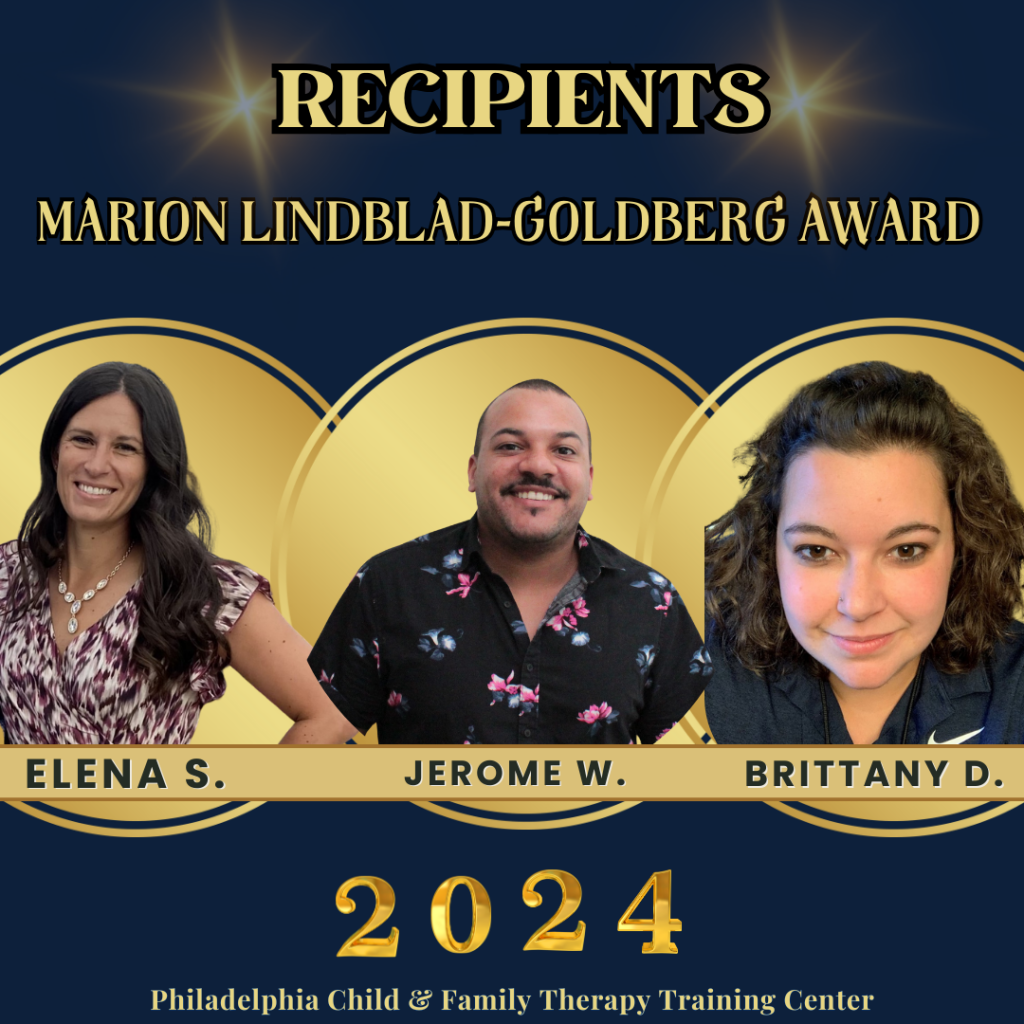
Congratulations, you have been nominated for the Marion Lindblad-Goldberg Award! This award recognizes and celebrates professionals from across the commonwealth of Pennsylvania shouldering the legacy of Dr. Marion Lindblad-Goldberg, creator of ecosystemic structural family therapy. Your nomination means someone has taken the time to tell us about how they believe you are working to make the world a better, brighter, and more connected place one family at a time. They believe wholeheartedly in you and your ability, through systemic and relational interventions, to heal disengagement and cultivate belonging!
“I believe Jerome embodies the legacy of Dr. Lindblad-Goldberg and he demonstrates it every time he enters the room as a trainer. Jerome has an unwavering belief in those he encounters and can instantly appreciate what anyone is willing to bring to the table. He also has a warmth that he continues to develop as a tool for validating and challenging others to grow when they are uncomfortable. I think the most nurturing part of Jerome’s presence, as a trainer, is his ability to hold himself accountable for his own growth and development before he asks others to venture into uncomfortable waters. This has resulted in him being able to continually hone his skills of creating simplicity in the face of complexity.”
Jenny says- “Over the last 3 ½ years I have been working in Family Based as the bachelor’s level clinician. If there is one thing I have learned, it is that this job is no joke. From the long workdays to crisis situations, what makes it worth it, is the families. It has been such an amazing journey to go through with the families and witness when they are willing to do something different about their situations at home. It is kinda crazy how much can change over the course of eight (8) months. I have worked with my partner, Jen Kirk, who has been doing this job well over 15 years and our differences have created a complimentary partnership in treatment. Over this period (3 ½ years), I have found my voice and learned my style. This process of competency has helped build my own confidence to the point that I have been excited to teach my new partner and help him develop his voice. I have learned various techniques, interventions, the importance of joining with families, and how to anchor skills for the long haul. I do not think I could have achieved this accomplishment without my supervisor, teammate, training cohort, and the training center. I am excited for what the future holds!”
Experience the rich tradition of innovative systemic family therapy training, education, supervision, & consultation, as established by Salvador Minuchin at the Training Center associated with the Philadelphia Child Guidance Clinic. Learn from expert faculty how to use a strength-based relational, contextual, developmental, & trauma informed approach to systemically treat intergenerational & complex developmental trauma.
The Philadelphia Child and Family Therapy Training Center, Inc. became a corporation in July, 1999, as an outgrowth of the as an outgrowth of the Training Center at the Philadelphia Child Guidance Clinic founded by Salvador Minuchin, M.D. in 1975 for systemic family therapy and training. The Philadelphia Child and Family Therapy Training Center offers Ecosystemic Structural Family Therapy (ESFT) training, education, consultation, and research in family and couples therapy, and developmentally based approaches to child, adolescent and adult behavioral health issues. The Center has trained thousands of mental health and other human service professionals in the practice of family therapy, examining the social ecology of the home, school, and community environments.
Keywords: Philafamily, training center, Philadelphia Training Center, Family systems therapy, systemic training, Ecosystemic Structural Family Therapy, Steve Simms PhD, Marian Lindblad-Goldberg, ESFT, Structural Family Therapy, Salvador Minuchin, Structural Family Therapy Training, Philadelphia Child Guidance Clinic, Continuing Education – Earn Your CE Credits Today, Online courses with clinical demos. Find comprehensive solutions for clinical challenges. Clinical demos, live sessions & detailed commentaries, Intergenerational trauma, Complex developmental trauma, MFT, AAMFT, APA, LPC, ACS, ACA, LSW, eco-systemic structural family therapy,
“Supporting families who have experienced trauma is not an easy task, especially when immersed in the family system as a clinician. As family therapists, we are constantly learning and growing, so I feel ESFT has given me such an effective, holistic, and solid foundation in being able to work with my clients. Becoming certified in ESFT with PCFTTC has been transformative and has bettered me as a family therapy clinician. The ESFT model has helped me to create better foundations with families, more thorough conceptualizations, and has increased my confidence in being able to find more effective ways to support my clients. Not only is the model beneficial for clinicians, but it supports families in being able to understand their feelings, experiences, and needs more clearly and in a way that progress/healing actually feels obtainable. Throughout my three-year training experience, I was taught by experienced and supportive instructors as well as support from peers within my agency and across PA. The graduation process immersed me into the model deeply with my real time clients and gave me an experiential opportunity that will be integrated into my practice for the rest of my career.”
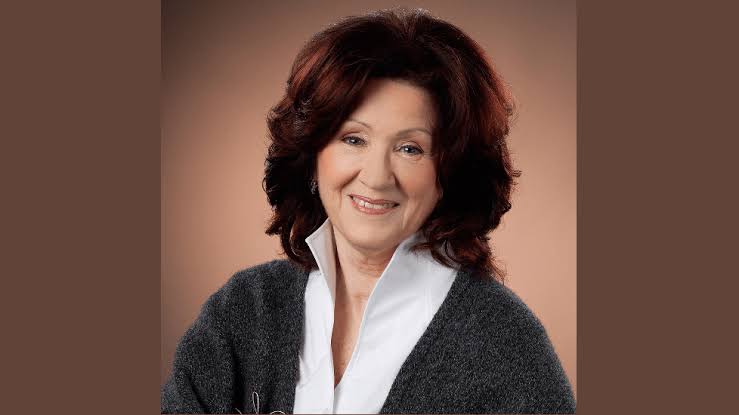
This award has been established by the Philadelphia Child and Family Training Center in honor of Dr. Marion Lindblad-Goldberg whose personal and professional mission was to make the world a better, brighter, and more connected place one family at a time. She believed wholeheartedly in each of us – in our ability, through systemic and relational interventions, to heal disengagement and cultivate belonging.
Each year the award is given to a trainer, clinician, and program director/supervisor, from the ESFT-FBMHS Training Program, who exemplifies the following:
Maintains a systemic perspective. Nominees have an appreciation for the isomorphic process in training, treatment, supervision, and across systems. Nominees maintain awareness of the “whole” while working the “parts.”
Maintains balance between professional boundaries and collaborative relationships to foster positive change and competence. Nominees take a strength-based approach, balancing their professional/expert knowledge while collaboratively engaging the ecosystem to draw on existing strengths and create experiences of trust, building individual competence for all members of the system.
Engages in social ecology. Nominees have a deep appreciation for intersectionality and the lived experiences of others. As such, they express an unwavering commitment to understanding how their own social ecology and zone of proximal development informs their professional work. Nominees consistently utilize their support system to engage in deliberate practice to grow their professional skills.
Makes the most of intensity and crises. Nominees have an ability to see struggle and chaos as an opportunity for growth and development. They demonstrate facilitative leadership by keeping second order change in the forefront of their approach to individual or system distress. They nurture others’ capacity to make meaning, promote new relational patterns and shift belief systems towards lasting change.
Assesses with complexity while acting with simplicity. Nominees have a belief that training, treatment and supervision are relational, contextual, developmental and trauma informed. They demonstrate these concepts actively in their work through systemic assessment and conceptualization. While their understanding of people and situations are complex, those around them experience the person’s actions and communication as accessible and validating.
Nomination are due by March 1st, 2024.
Nominees and Recipients will be previewed across social platforms.
Winners announced on June 3rd, 2024.
Recipients of the award will celebrate with PCFTTC Faculty & receive access to homestudies.
On April 1st, 2021 the RCPA publish survey outcomes for 74 responding organizations, 46 were behavioral health providers. This executive summary specifically denotes findings for behavioral health agencies:
o Primary uses were individual therapy, group therapy, and monitoring of psychiatric medications.
o Primary funders were Medicare (50.0%) and private insurance companies (78.3%).
o Use of telehealth was associated with increased costs.
o 68.9% of behavioral health respondents reported that efficacy remained the same or improved.
o Provider satisfaction with telehealth procedures approached 96%, while perceived consumer satisfaction reached 85%.
o 80% of agency were receiving payment for telehealth services on time, 15% reported sometimes a delay, and three respondents reported not having received full or any payment at all.
o 88% of respondents indicated that a waiver of existing regulations or standards enabled the use of telehealth procedures.
O 82% of respondents favor zoom as the telehealth vendor.