
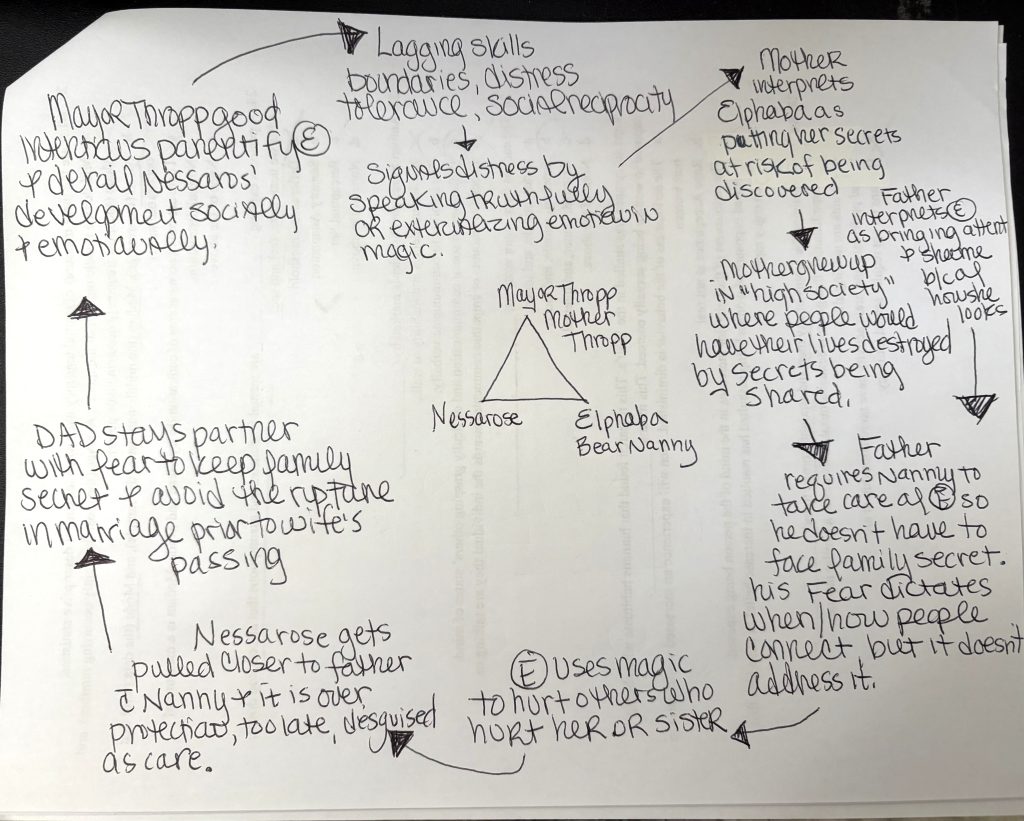
As part of our Wicked Competition, participants were invited to apply Ecosystemic Structural Family Therapy (ESFT) concepts to the world of Wicked—and one submission stood out for its clarity, creativity, and clinical precision.
The winning entry mapped the family system using both an ecomap and a Negative Interactional Pattern (NIP). Featured here is the NIP, which places Nessarose, Elphaba, the Bear Nanny, Mayor Thropp, and Mrs. Thropp as part of the triangle.
Rather than focusing on individual pathology, the NIP highlights how each person’s responses are relationally organized and mutually reinforcing. Within this triangle, well-intentioned caregiving, protection, and authority intersect in ways that unintentionally intensify disconnection, over-responsibility, and emotional isolation—particularly for Elphaba and Nessarose.
From an ESFT perspective, the NIP illustrates how:
- Caregiver fear and societal pressure shape parental leadership
- Protective behaviors escalate rather than soothe distress
- Children are pulled into roles that strain attachment and emotion regulation
- The broader ecology (including loss, stigma, and power) amplifies family stress
What made this submission especially strong was its ability to show how everyone is doing the best they can within a system that needs support—not blame. The NIP becomes a roadmap for intervention, pointing clinicians toward strengthening leadership, clarifying roles, and shifting interactional sequences rather than “fixing” a single character.
Congratulations to our Wicked Competition winner for reminding us that even in Oz, behavior makes sense in context—and systems, not individuals, are where change begins.