We’re excited to share several meaningful updates and opportunities from the Training Center this month. From celebrating excellence in the field to continuing our commitment to trauma-informed practice, there’s a lot happening across our community.
Nominees Announced: 2026 MLG Award We are proud to recognize this year’s nominees for the 2026 MLG Award. Each individual reflects a deep commitment to systemic thinking, clinical excellence, and service to families. We look forward to highlighting their work and celebrating their contributions in the coming weeks.
Honoring a Pioneer This season, we also take time to honor a pioneer, Dr. Edna Foa, whose work has helped shape the foundation of trauma treatment. Her contributions will continue to influence how we support those in our community.
Trauma-Informed Care in Practice As we continue to deepen our focus on trauma-informed approaches, we remain committed to supporting professionals in understanding how trauma shows up across family systems, and the need to “provide options” if we are going to be trauma informed.
Register for Our Free CE Program We invite you to join us for our last free Continuing Education (CE) program for the training year. Whether you are a clinician or a supervisor you will want to be present. Learn about all things isomorphic. Be sure to reserve your spot and stay connected for upcoming offerings later this year.
Thank you for being part of our community and for your continued dedication to the families you serve.
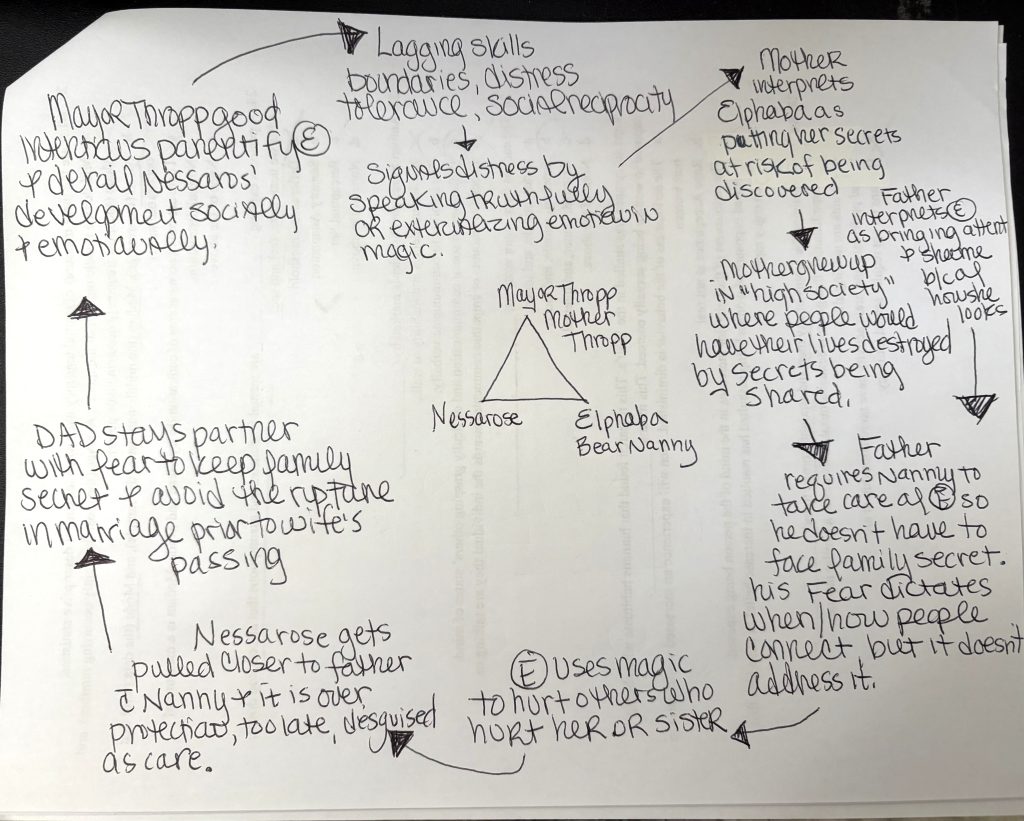
As part of our Wicked Competition, participants were invited to apply Ecosystemic Structural Family Therapy (ESFT) concepts to the world of Wicked—and one submission stood out for its clarity, creativity, and clinical precision.
The winning entry mapped the family system using both an ecomap and a Negative Interactional Pattern (NIP). Featured here is the NIP, which places Nessarose, Elphaba, the Bear Nanny, Mayor Thropp, and Mrs. Thropp as part of the triangle.
Rather than focusing on individual pathology, the NIP highlights how each person’s responses are relationally organized and mutually reinforcing. Within this triangle, well-intentioned caregiving, protection, and authority intersect in ways that unintentionally intensify disconnection, over-responsibility, and emotional isolation—particularly for Elphaba and Nessarose.
From an ESFT perspective, the NIP illustrates how:
Caregiver fear and societal pressure shape parental leadership
Protective behaviors escalate rather than soothe distress
Children are pulled into roles that strain attachment and emotion regulation
The broader ecology (including loss, stigma, and power) amplifies family stress
What made this submission especially strong was its ability to show how everyone is doing the best they can within a system that needs support—not blame. The NIP becomes a roadmap for intervention, pointing clinicians toward strengthening leadership, clarifying roles, and shifting interactional sequences rather than “fixing” a single character.
Congratulations to our Wicked Competition winner for reminding us that even in Oz, behavior makes sense in context—and systems, not individuals, are where change begins.
🌪️ A playful, clinically grounded way to think about family dynamics through the world of Oz
Elphaba — The “Identified Patient” Who Carries the System’s Anxiety
Elphaba represents the youth who is labeled as “the problem” simply because the system doesn’t understand or accommodate their uniqueness. In ESFT terms, she is the symptom bearer—not because she’s broken, but because her family, community, and social ecology project their fears and failures onto her. Her journey mirrors the work of helping a child reclaim identity, voice, and relational belonging.
Glinda — The Caregiver Who Uses Performance to Maintain Harmony
Glinda embodies the caregiver (or sibling) who copes through positive affect, charm, and high sociability. Her role keeps peace but often hides insecurity. In systemic therapy, she symbolizes the family member whose over-functioning or “performer” role helps stabilize the system—but prevents vulnerability. Her friendship with Elphaba demonstrates the healing power of authentic connection.
Fiyero — The Avoidant Attachment Partner Afraid to Choose
Fiyero mirrors the person in the system who avoids emotional engagement—“fun,” charming, but disconnected. He represents a protective adaptation, not a flaw. Through relationship with both Glinda and Elphaba, he learns the core principles of systemic change:
Responsibility
Presence
Emotional risk-taking
The Wizard — The Larger System That Creates the Problem It Claims to Solve
The Wizard symbolizes structural forces—policies, institutions, and leaders—that blame individuals while perpetuating dysfunction. He is the metaphor for:
Oppressive systems
Pathologizing narratives
Blame-shifting structures In family therapy terms, he is the “macro-system stressor” shaping how families respond to crisis.
Madame Morrible — The Rigid Hierarchy That Reinforces Dysfunction
Morrible represents the family system’s coercive hierarchy—a figure who uses fear, control, and manipulation to maintain order. Her “weather patterns” metaphorically mirror how emotional climates in families are often shaped by the most powerful or reactive members.
Nessarose — The Child Caught in the Bind of Overprotection
Nessarose is the sibling who receives intense focus—overprotection disguised as care. Her storyline reflects how enmeshment and over-dependence can limit growth and create resentment, despite good intentions. Her dynamic with Elphaba shows what happens when families assign fixed roles (“the responsible one,” “the helpless one”).
Boq — The Marginalized Member Who Adapts Until He Breaks
Boq embodies the overlooked, underheard member of the system who tries to earn belonging through compliance. His unmet needs eventually transform him—literally—revealing how suppressed emotions can reshape functioning. He is the metaphor for accommodation patterns and role strain.
Dr. Dillamond — The Silenced Voice of Wisdom
Dillamond represents the voice in the system that sees the truth but is ignored or suppressed. He symbolizes the disenfranchised perspective—the teacher, elder, or natural support whose insight is essential to systemic change, but often marginalized.
Dorothy (Part 2) — The Newcomer Who Exposes Existing Fault Lines
Dorothy is the outsider whose arrival destabilizes a fragile system. Her presence reveals:
unresolved grief
fractured alliances
long-standing injustices She is the catalyst that forces the system to confront its hidden patterns.